Wrecks you don't need a boat to see
Plenty of ships came to grief on this coast on the way to Port Phillip. Most are under water now. Two left anchors you can walk up to in a park. One is on the Torquay foreshore, a few minutes from the house. The other is at Barwon Heads, about 25 minutes east.
It's a short outing, not a day trip. The Torquay anchors fit into a walk along Front Beach. Barwon Heads is the older story, from the gold rush, and makes a good second stop. Kids who've had enough of rock pools will usually manage an anchor, a plaque and an ice cream.
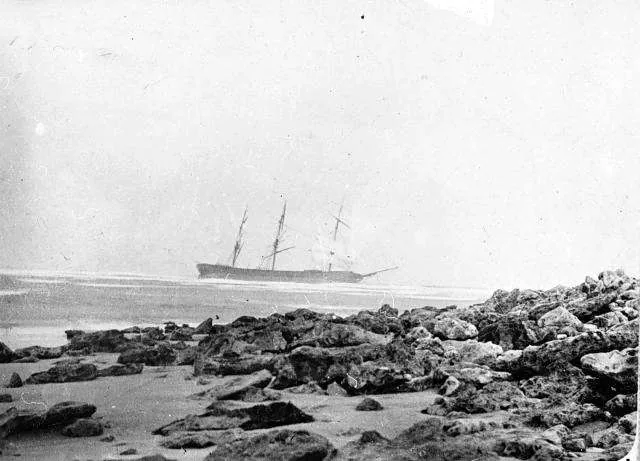
The Joseph H. Scammell, at Point Danger
The Joseph H. Scammell was a wooden ship, built in 1884 at Eaton, New Brunswick. In 1891 she was on her way from New York to Melbourne with a mixed cargo: kerosene, hardware and general merchandise, according to Heritage Victoria. While she waited off the coast for a pilot, a strong current pushed her inshore onto the reef at Point Danger, the headland between Front Beach and the surf beach.
Torquay Museum Without Walls puts the wreck on the night of 7 May 1891, about 400 yards off the beach, and says everyone aboard was brought ashore the next morning. The captain's wife and daughter were on board too. Heritage Victoria's record has 27 May, so you'll see both dates around. We've gone with the museum's.
The anchors are what's left to see. The museum describes a large anchor on the Torquay foreshore, pointing out towards where the ship was lost, and a smaller one at Fishermans Beach by the boat ramp. Heritage Victoria mentions three anchors raised by the Geelong Skindivers Club, so keep an eye out for a third. It's 5 to 10 minutes in the car from the house, or a longer walk along the foreshore.
The wreck itself is in the Point Danger marine sanctuary, where fishing and taking anything from the reef are both banned. Our Point Danger guide has the rock pools and the lookout above it.
The Earl of Charlemont, at Barwon Heads
This is the older wreck. On 18 June 1853 the Earl of Charlemont, carrying immigrants to the gold-rush colony, hit the reef off Point Flinders at Barwon Heads. The memorial cairn in the park says about 450 people landed "from the wreck and the breakers below". Some of the survivors stayed and settled nearby.
The anchor sits on a stone and concrete platform with a plaque in Barwon Heads Park, on Ewing Blyth Drive. It's heritage-listed, and parts of it are rusting from the inside, so admire it from the ground. The cairn is in the same park. It was unveiled in November 1953, a hundred years after the wreck.
From the house it's about 25 minutes: Horseshoe Bend Road, Blackgate Road and Breamlea Road, then Barwon Heads Road into town. You don't go anywhere near Geelong. If you're heading that way anyway, it pairs well with a morning at Breamlea and Lake Connewarre.
The wreck our street is named after
Holyday House is on Holyhead Drive, and Torquay Museum Without Walls tells us the street is named after a shipwreck too. The Holyhead was a brand-new iron sailing ship, built in Liverpool in 1889 and on her maiden voyage from Liverpool to Melbourne. On 12 February 1890 she reached Port Phillip Heads in thick weather and heavy seas. She signalled for a pilot, got no answer, and stood in towards the land. The lookout raised the alarm, the crew tried to turn her and let go the anchors, but she struck Lonsdale Reef and stuck fast.
She was carrying about 1,000 tons of iron rails, 1,000 tons of roofing slate, and liquor and general cargo, worth around £60,000 in all. All 32 crew got off safely. Heritage Victoria lists the wreck as historically significant, because she was a top-rated ship from a well-known Liverpool yard, lost on her very first voyage. A photo held by the Australian National Maritime Museum shows her stranded off Point Lonsdale. You can see the reef from the lookouts at Point Lonsdale, which is in our Queenscliff day trip.
Once you know, you'll spot the theme all over our part of north Torquay. Around the house there's Scammell Crescent, after the ship in this guide, Glaneuse Avenue, after a barque wrecked at Point Lonsdale in 1886, and Loch Ard Drive, after the most famous wreck on the Shipwreck Coast. Orungal Court is named for the steamer that ran onto the reef off Barwon Heads in 1940, and Casino Court for the steamer lost at Apollo Bay in the 1930s. The walk to Whites Beach is a short history lesson if you read the street signs.
When to go
Any time. The anchors are on public foreshore, so there are no opening hours and nothing to book. Early morning is quiet, and in summer you'll have Front Beach to yourself before the crowds arrive.
Go at low tide if you want to walk out onto the rock platform at Point Danger afterwards. In winter, keep an eye on the water from the lookout, because whales sometimes pass close to shore. Our Point Danger guide has more on both.
On a wild day, stand at the foreshore anchor and look out to the reef. With a southerly swell breaking over it, it's easy to see how a sailing ship waiting for a pilot ended up there.
Making a morning of it
Torquay, on foot
Park once near Front Beach or Fishermans Beach and walk between the anchors. If the tide's low, carry on to the rock platform at Point Danger. The beaches guide sorts out which beach is which, and the boat ramp is in the fishing guide.
Barwon Heads, by car
A wander around the park to see the anchor and the cairn, then the bridge and the river mouth if you want to stretch it out. Our Barwon Heads guide has the rock pools at the Bluff and lunch on the jetty.
Leave the reef alone
The Scammell is a protected historic shipwreck. It's been picked over by salvagers and divers since 1891. Don't take timber, copper, crockery or anything else from the rocks or the water.
Shipwreck anchors FAQ
Where is the Scammell anchor?
There's a large one on the Torquay foreshore and a smaller one at Fishermans Beach, both with plaques. They're 5 to 10 minutes' drive from the house.
When was the Joseph H. Scammell wrecked?
In May 1891. The Torquay museum says 7 May, and Heritage Victoria's record says 27 May.
Can I see any of the ship itself?
Not really. What's left is on the reef in the marine sanctuary. The anchors on shore are the part you can visit.
Where is the Earl of Charlemont anchor?
In Barwon Heads Park on Ewing Blyth Drive, with the memorial cairn nearby. It's about 25 minutes from north Torquay via Barwon Heads Road.
Did everyone survive the Charlemont?
The cairn says about 450 people landed. It doesn't say whether anyone was lost, and the passenger counts vary.
Why is Holyday House on Holyhead Drive?
The street is named after the Holyhead, an iron ship wrecked on Lonsdale Reef at Port Phillip Heads on her maiden voyage in February 1890. All 32 crew survived. Many streets nearby are named after local wrecks too.
Is it good with kids?
Yes, as a short stop. The Torquay anchors are on grass by the beach, with the playground and the rock pools close by.
The headland itself is in the Point Danger guide. The beaches either side are in Torquay beaches, and the drive east past the lake is Breamlea and Lake Connewarre. To stay a few minutes from the foreshore, check dates and send an enquiry.
Sources
Facts on this page were checked against these sources on 19 October 2026. Opening hours, patrols, rules and closures change — check with the source before you go.
- HOLYHEAD — Victorian Heritage Database
- The shipwrecks the Glanuese and the Holyhead off Point Lonsdale — Australian National Maritime Museum
- Holyhead wrecked, all crew safe (Feilding Star, 15 February 1890) — Papers Past
- Email from Torquay Museum Without Walls, 19 October 2026 — Torquay Museum Without Walls
- S.S. Casino — Victorian Collections
- Orungal teacup (Geelong Naval and Maritime Museum) — Victorian Collections
- Joseph H Scammell — Torquay Museum Without Walls
- Saving the Scammell — Torquay Museum Without Walls
- A brief history of Torquay — Torquay Museum Without Walls
- Shipwrecks — Torquay Museum Without Walls
- JOSEPH H. SCAMMELL — Victorian Heritage Database
- Joseph H. Scammell wreck report — Heritage Victoria
- Earl of Charlemont Anchor — Victorian Heritage Database
- Earl of Charlemont Memorial Cairn — Victorian Heritage Database
- EARL OF CHARLEMONT — Victorian Heritage Database